
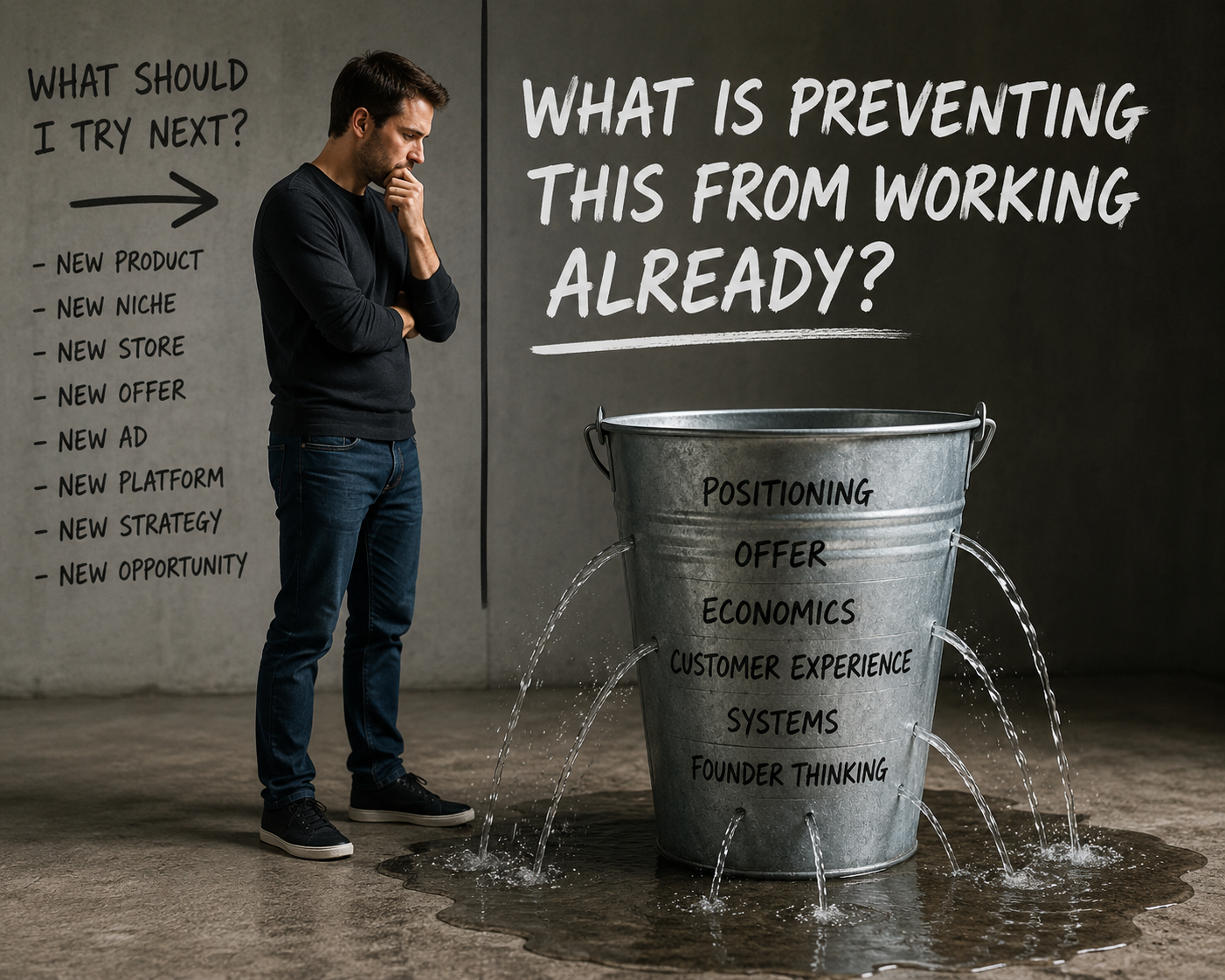
#001. The Opportunity Trap: Why Founders Keep Searching For Another Bucket
Hi – it’s Rebecca.
For years, I believed growth came from finding the right product. A better niche. A bigger market. A stronger opportunity.
If sales were disappointing, surely the answer was simple:
Find a better product.
It’s an easy trap to fall into – in fact, it’s one of the first leaks many founders encounter.
I call it The Opportunity Trap: the belief that the answer is always somewhere else.
Another niche. Another product. Another market. Another business model. Another bucket.
The problem isn’t that opportunities don’t exist. The problem is that opportunity often disguises itself as progress.
Every new idea brings excitement. Every new launch feels full of possibility. For a while, motivation returns.
Then gradually, the same problems appear again.
The sales don’t come. The margins disappoint. The growth feels harder than expected.
And before long, you’re looking for another opportunity – not because you’ve found the real problem, but because you’ve found temporary relief.
That’s the first leak.
Many founders assume they need another bucket. What they actually need is to find the leak in the one they already have.
Weak positioning. Poor economics. An unclear offer. Trying to scale before the foundations are ready.
Whatever the cause, fixing the leak matters far more than finding another opportunity.
The businesses that compound aren’t constantly reinventing themselves. They’re strengthening what already exists.
One better offer. One better customer experience. One better decision. Then another. And another.
Over time, those improvements compound.
The next time you’re tempted by another product, another niche, or another opportunity, pause and ask yourself:
Am I searching for a solution? Or am I searching for relief?
Because adding more water to a leaking bucket rarely fixes the leak. Finding the leak does.
The Product Hunt Never Ends
One of the challenges with ecommerce is that there is always another opportunity.
Every day there’s another niche being discussed. Another product going viral. Another founder sharing a success story. Another expert explaining why this market is different.
When things aren’t working, it’s incredibly difficult not to look at those opportunities and wonder whether you’re simply working on the wrong thing.
I’ve done it myself more times than I’d like to admit.
The next opportunity always looks cleaner than the business you’re currently wrestling with. The current business contains uncertainty, unanswered questions, and frustrations you’d rather avoid. The new opportunity contains possibility.
So you move.
The next product feels exciting. The next launch feels full of potential and, for a while, motivation returns. Everything feels possible again.
Then gradually the same problems begin to appear. Sales remain inconsistent, margins feel tighter than expected, and growth feels harder than it should. Customers don’t respond the way you hoped, and before long you’re searching again.
The danger with opportunity is that it always arrives disguised as progress.
That’s one of the hardest lessons ecommerce ever taught me.
Because movement and progress are not the same thing.
Looking For Constraints
Long before ecommerce entered my life, I became fascinated by a different question:
Why do some people improve while others remain stuck despite working just as hard?
Back then it was cycling.
I spent years training, racing, reading and analysing performance, trying to understand why some athletes continued to improve while others seemed trapped on the same plateau year after year.
What confused me was that effort rarely explained the difference.
The athletes who plateaued weren’t lazy. Many were training just as hard as the athletes who were progressing. Sometimes harder.
Eventually I realised the breakthrough rarely came from adding more effort. More often, it came from identifying the thing preventing the effort from producing results in the first place.
One rider needed better recovery. Another needed more patience. Another needed less training, not more.
Business works exactly the same way.
The Founder Thinking Shift
One of the biggest shifts I’ve made over the years is this: when something isn’t working, your instinct is usually to ask:
“What should I try next?”
Mine was too.
But eventually I realised that question rarely led me to the real answer. A better question was:
“What is preventing this from working already?”
At first glance, those questions sound almost identical.
They’re not One question searches for opportunities. The other searches for constraints. One looks outward. The other looks inward.
And in my experience, the biggest breakthroughs usually happen when you stop searching for more and start understanding what’s already there.
Sometimes the leak is weak positioning. Sometimes it’s poor economics, a confusing offer, or trying to scale before the foundations are ready.
Whatever the cause, finding the leak matters far more than finding another product.
The Businesses That Compound
The businesses I admire most aren’t constantly reinventing themselves.
They’re not rebuilding every six months. They’re not chasing every trend that appears in their feed. And they’re not abandoning a business the moment growth becomes difficult.
Instead, they’re quietly strengthening what already exists.
They improve the offer. They improve the customer experience. They improve the economics. They improve the systems behind the business. Then they allow those improvements to compound over time.
From the outside, that process often looks boring.
There’s no dramatic pivot. No exciting new niche. No announcement that changes everything overnight.
But compounding usually does look boring.
That’s one of the reasons so many founders miss it.
We’re naturally drawn towards breakthroughs. We like the idea of finding the thing that changes everything. The winning product. The perfect advert. The hidden opportunity nobody else has discovered yet.
The reality is often far less exciting.
Most successful businesses are built through hundreds of small improvements made consistently over many years.
- One better offer.
- One better customer experience.
- One better decision.
- Then another.
- And another.
Eventually those improvements begin to stack on top of each other. That’s when growth starts to feel easier. Not because you’ve discovered a secret.
But because you’ve spent enough time fixing leaks.
A Question Worth Considering
The next time you find yourself looking at another product, another niche, or another opportunity, pause for a moment.
Ask yourself whether you’re searching for a solution or simply searching for relief.
There’s a difference.
Relief feels good because it gives you something new to focus on. It creates excitement. It creates momentum. But excitement and progress aren’t always the same thing.
Sometimes the most valuable thing you can do isn’t start something new. It’s stay still long enough to understand what’s already in front of you.
What if the next product isn’t the answer?
What if it’s simply a distraction from the real problem?
Because adding more water to a leaking bucket rarely fixes the leak.
Finding the leak does.
This Week’s Leak
If you’re currently looking for another opportunity, ask yourself: Is the opportunity really the problem? Or have you simply not found the leak yet?
The next product often solves the boredom of the current one. It rarely solves the underlying constraint. So before you start over, ask yourself: Have you actually found the leak?
Or, have you simply found another bucket?
What do you think?
Reply and let me know!
Until next Saturday,
Rebecca
Other Leaks You Might Have Missed…
#002. The Validation Trap: The Assumption I Didn’t Know I Was Making
#003. The Giving Up And Starting Over Trap.
#004. The Amazon Shutdown That Changed Everything